Writing
One More Step
I am sitting here almost a year later, trying to write it down before the details become blurry. Because it’s already fading — the way all hard things do once you survive them. The photos stays sharp. The emotion gets soft around the edges. I want to write it down while the fear still feels real.
Why Now
I quit my job a few months back. I am trying to build things on my own — a few products and a few bets. Some mornings are genuinely good and exciting. But other mornings I wake up and can feel the struggle.
When you are building on your own, you have to create momentum and persit it. There are no users yet to pull you in a direction, no feedback to tell you what is real, no small sign that something is working. So you drift. One tab becomes ten. One idea becomes another. You can spend a whole day moving and still not know if you went anywhere.
One of those mornings I was struggling and questioning my choices, and I remembered the climb. And realised: I had already been in this situation before. Not in the co-working space but on ice, At 6,000 metres.
Kang Yatse II
Kang Yatse II is a 6,250m (20,505 feet) peak in the Markha Valley, Ladakh. It was my first 6,000m expedition. I had done treks before — multi-day ones, some hard ones. But nothing that required crampons, ropes, or the phrase summit attempt.
There were three of us, plus four guides. After trekking for around 4 days (Markha -> Hankar -> Nimaling) we reached base camp. Got acclimatised, rested and a bit of training, we were ready for the summit push. We started the ascent from base camp at around 5,100m (16,700 ft). We left at 11 PM, because you have to reach the summit before 9 or 10 AM — after that, the sun softens the ice and the mountain becomes something else entirely.
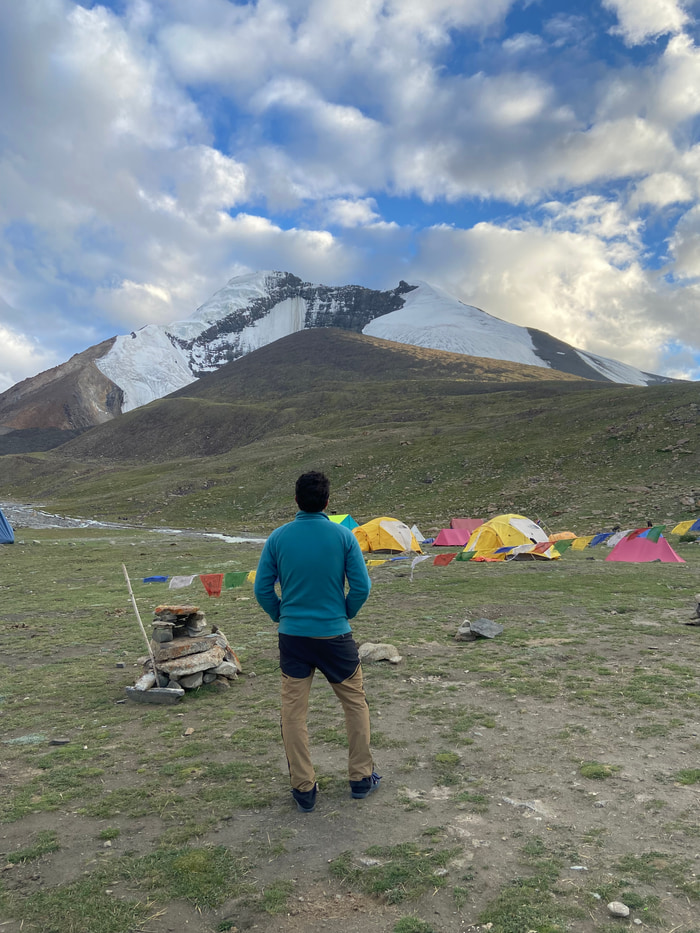
Before we left — the day before, actually — there was a short drill on how to walk in crampons. Not on ice — just on ground. How to place your feet. How the harness fits. That was it. That was my preparation.
I don’t really look up treks before doing them. No YouTube, no blogs. Suryansh asked me to join and I just said yes. There were three of us going for the summit — me, Suryansh, and another girl. I did not fully understand that the entire ascent was going to be on ice until I was already on it.
I don’t know what I expected. Something more like trekking, I suppose. Difficult, yes. But not categorically different.
The First Hour
Suryansh turned back early. He was already showing signs of altitude sickness — and turning around was the smart move. He read the situation clearly before it could get worse.
Now we were two of us, plus three guides.
After Suryansh turned back, we kept going. We trekked for another hour and a half before reaching the base of the ice section. On the way, it started hailing. We stopped right there in the hail, put on our crampons, got all our gear on.
It was only when we stopped to put on the crampons and I looked up properly and understood — this whole ascent was going to be on ice. I don’t know what I had imagined before that. Maybe something like trekking, just harder. But in trekking, even when it gets harse, there is still some version of stopping. You get tired, you sit for ten minutes, you recover a little, and then you continue. On ice there is no sitting. You can stop and stand, that’s all. Your legs are still hurting. Your feet are still on the slope.
The lead guide went first, the girl behind him, and me.
I remember putting my first foot on the ice. My ankle — it wasn’t moving the way I wanted it to. The shoes are built stiff, that’s the point of them, but when you’ve never worn them before, that stiffness is just pain. And the slope. I felt it immediately — this is not going to be easy.
We started moving. She was ahead of me, and she was slow, which actually helped — it gave me time to find my footing, brute force each step. We kept going like that for a bit.
Around 40-50 metres in, she slipped. Came back onto me. The guides saw it and knew — at this pace, we wouldn’t make the summit in time. She didn’t want to stop. She’d come all this way. They gave her one more chance, said let’s see how the next stretch goes, and if it’s not working we will have to make a final call.
It wasn’t working. She turned back. One guide went with her.
Now it was two guides and me.
The guild who was going back — Ajay, someone I’d trekked with before — came close and said quietly in my ear: “You have to make it.”
Suryansh left. The girl left. Both of them are fine. Both of them are alive. Why am I suffering here? That’s genuinely what was going on in my head. Not some deep existential thing, just — what is the point of this? You climb it, you come back tomorrow, life continues. Nothing changes. So what. And now this guy is telling me I have to make it, and I’m even more scared because now it feels like there’s pressure, and I’m thinking maybe I should just tell him let’s go back. I don’t want to be here. This makes no sense.
The Word I Did Not Say
Here is the thing about that climb that I have thought about multiple times.
At a certain point — maybe an hour in, maybe less — I knew it was possible to go back. All I had to do was say it out loud. If I said I can’t continue, they would have turned around with me. No judgment an back to base camp.
I knew this. But something inside me was stopping me.
Not because I was not suffering. I was. I was sweating through my inner layer even though it was freezing. I was not moving fast. The guides were pulling ahead and I was catching up and falling behind and catching up again. Every part of me was begging for a reason to just say the word.
But I kept on thinking: if I say it out loud, it will become real.
The suffering was real. But untile you say it out laud it’s not real. Kept saying, Just one more step. Don’t say it. One more step. Don’t say it. One more step.
I don’t know how many times that loop ran in my head. Hundreds. Maybe thousands. Each step was its own small negotiation.
The Midpoint
Somewhere before the midpoint, another thought started coming in: how do you even know when you are pushing hard is good or too much? After a point, it is not a very logical decision. One part of you keeps saying, just push, one more step. Another part is asking, am I being stupid here? Am I crossing a line I should not cross?
And on a mountain, that thought is not dramatic. It is real. If you push past the wrong line, things can go very bad.
Around the midpoint, there was a small patch of rock where the ice broke. It was just enough space to sit for a few minutes and take the weight off my feet. We stopped there. I sat down and said nothing. My shirt was completely soaked.
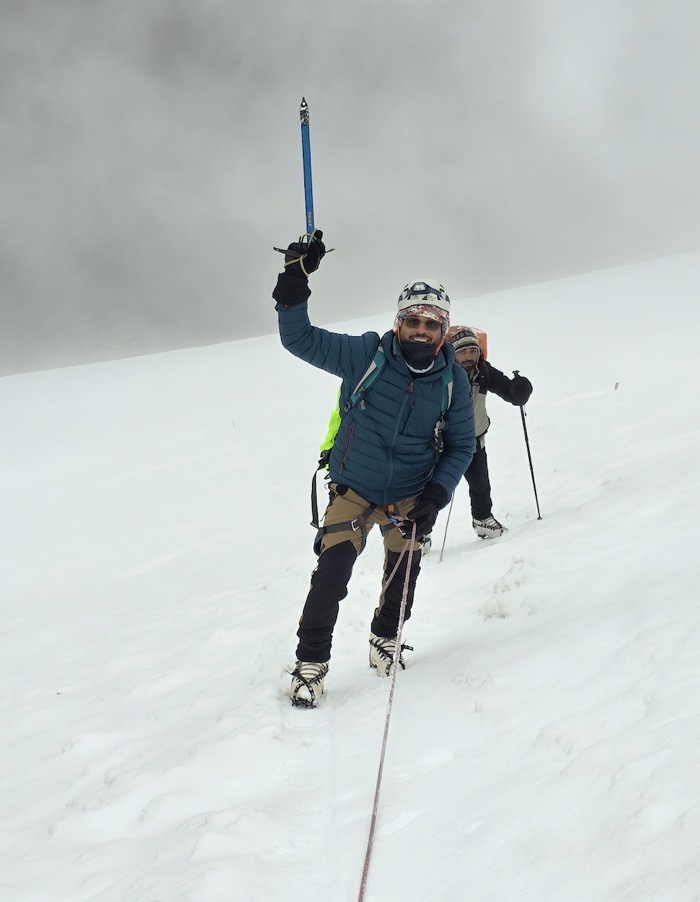
A climber with guide came down past us. I asked him how long to the summit.
He said: Two, maybe three more hours.
Two or three more hours of this. And then the descent. That was the first time I remember wondering if I was pushing too much. When you are already inside something hard, it is not always clear what is courage and what is stupidity. You keep telling yourself to push, but you also don’t know where the line is. And on a mountain, crossing that line can go very wrong.
Hearing that broke something in me for a moment. I remember going quiet for a moment and taking out my phone. I don’t fully know what I was thinking, but some part of me was like — if something happens, at least this will exist. At least there will be some proof that I was here, that I tried, that I chose this.
A lot of things came all at once. I wanted to say what I was actually feeling, but the guide was standing right there. And I thought if I say what I wanted to maybe the guide will be worried, and he would know how scared I was. So I just smiled and spoke like it was a normal trek, said something generic, and stopped recording.
After resting for a bit we started again.
The Summit
After the midpoint it was just — ascend, stop for a breath, catch it, keep going. Stop, breathe, keep going. At some point I stopped thinking entirely. I was just moving.
And then the lead guide pointed ahead and said that’s the summit. Something in my chest just — released. Like I’d been holding something for hours without realising it and it finally let go. We kept walking for a bit more and then we were there.
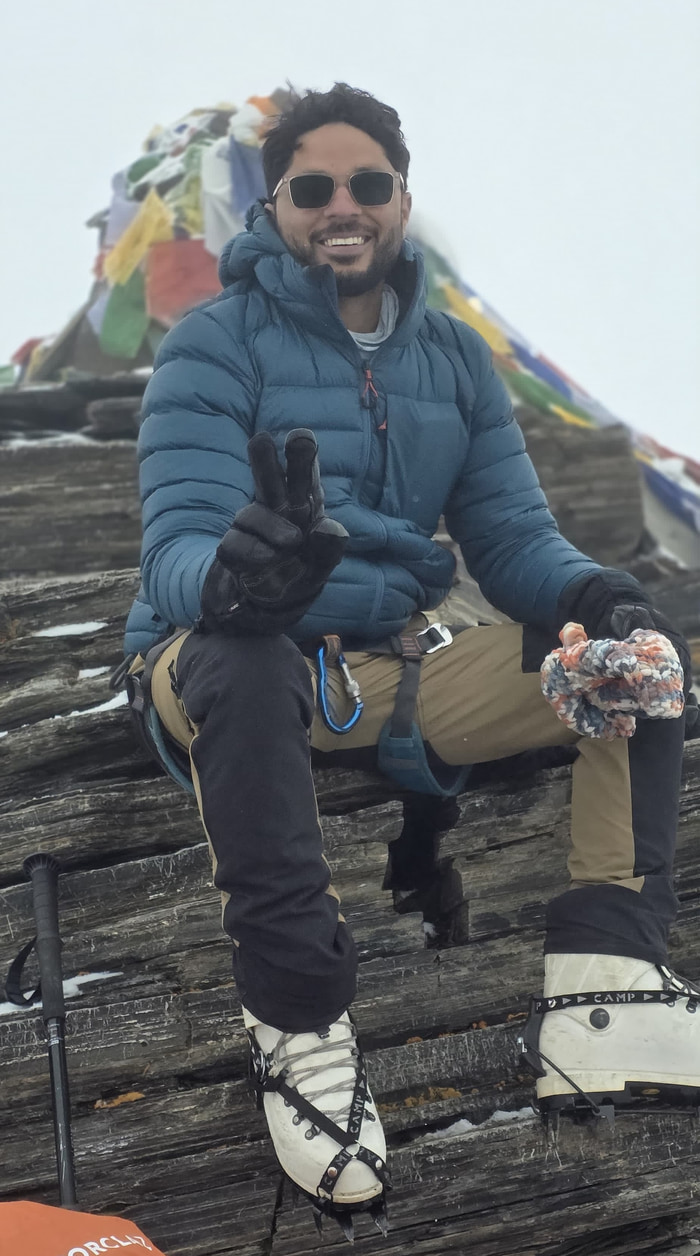
The weather was cloudy, but whatever you could see — it was beautiful. A bit fuzzy, a bit unclear, but magnificent in a way I don’t fully have words for. On one side I could see Kang Yatse I, and just looking at it I understood — that one is a different beast entirely. More technical, more tricky, a proper mountaineering objective. On the other side, smaller mountains, one behind another, going on forever. At 6,200m you can see so far that they just keep appearing, layer after layer, and it looks like the mountains have no end.
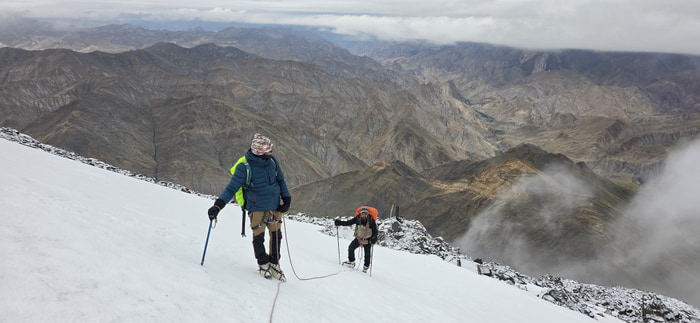

And then I realised there was network. The whole trek, nothing. And here at 6,200 metres, full network. One of the guides was on a video call with his family. I sent a few messages. Sat down. My body was done. We stayed for maybe half an hour, congratulating, resting, taking photos. It was around 8 AM by the time we got there.
Coming Down
Sitting on the summit, all I could think was — I also have to go down.
I had heard people say descending is harder than going up. But by that point my mind was just numb. I had reached. There is no point in thinking anymore. The only way to survive is to go down. There is only one thing that has to be done, so you just do it.
The whole way down I was just copying the lead guide. How he placed his crampons, when he slid, how he used his weight. I wasn’t thinking. I was just watching him and doing the same
The clouds actually helped. Coming down Kang Yatse you can apparently see the whole slope below you — the angle, how far it drops, all of it. That view can get in your head. But the visibility was maybe 10 to 20 metres. I couldn’t see what was there after that. So I didn’t think about it. Just the guide in front of me, just the next step, just keep moving.
We came down fast on ice. Faster than expected. I slipped into a couple of crevasses on the way, the rope went tight and they pulled me back up. Cold shock, then moving again. Just keep moving.
After the ice it was another two hours down the mountain on foot. It was raining by the time we reached base camp.
What Changed
We reached base camp completely drenched. Subodh — the founder of the company I had gone with (TVT), someone I’ve done enough treks with to now call a friend — congratulated me. Everyone did.
Before the trip, we had a plan of doing two summits back to back. Kang Yatse II first, then a night’s rest, then Dzo Jongo — another 6,000m peak nearby, supposedly a bit more forgiving. Subodh asked me, almost immediately after the congratulations: so what do you say now about the next one?
I said never again. I think those were my exact words. Never again. He laughed and told me he’d talk to me in a few days.
He was right to laugh.
A couple of days later, something had quietly shifted. The exhaustion was gone. And what was left was something I hadn’t expected — not just pride, but a kind of recalibration. Before this climb, I thought I knew my limits. I had never actually hit them. I had always been able to sit down for five minutes, recover, and continue. Every step on Kang Yatse was different. Every single step was the struggle I always thought would never happen to me. And I had kept going anyway.
I didn’t go for Dzo Jongo that trip. But I said yes to the idea of going back someday.
One More Day
Last week, one of these days I had a bad morning (one of many). The kind where you open your laptop and there is no new progress — no installs, no feedback, nothing moving. Just silence. Those are the mornings that get to you when you’re building alone.
And then it just came back to me. That loop. One more step. Don’t say it. One more step.
Except now it’s One More Day.
If you’ve done any Himalayan expedition or are thinking about it, I’d love to talk. And if you’re building something alone and finding the mornings hard — same.
August 1, 2025 · Markha Valley, Ladakh · 6,250m